
This work is part of an ongoing cycle exploring ambivalent states of contemporary existence.
Title: Self-Portrait
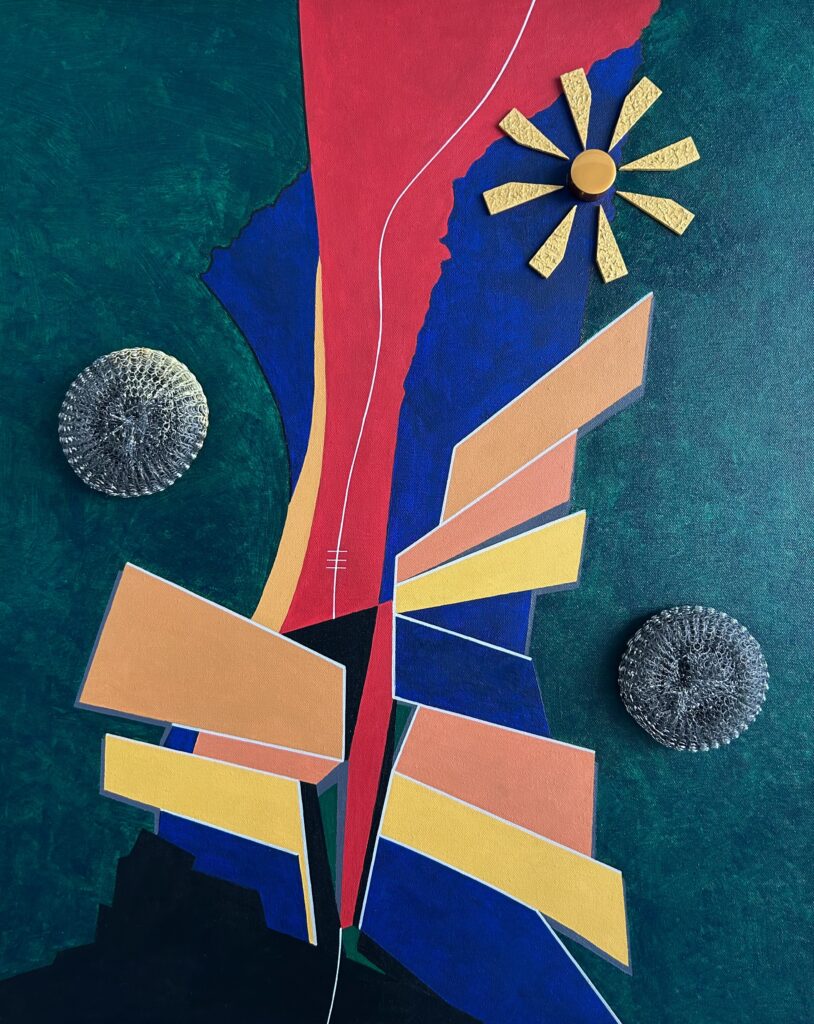
Medium: Acrylic and assemblage on canvas, with metal mesh and relief elements
Year: 2026
Format: Portrait format (24 × 30 inches)
Colour Space: Petrol green, cobalt blue, red, apricot, and ochre, with accents in black, white and metal
Stylistic Classification: Symbolic-geometric abstraction / mixed-media assemblage
„Self-Portrait” does not depict one identity being replaced by another, but the transformation of a life. A red axis rises from a heavy black base through displaced planes of colour. The construction evokes a distant bodily presence, yet remains fractured and permeable. Metal mesh and relief elements appear as material traces of an identity in transition.
The Past as a Foundation
The geometric clarity and weight of the lower section represent a life sustained by professional responsibility, discipline, and acquired security. This order does not appear as a prison, but as a reliable framework that makes the later departure possible.
The red axis gains increasing force as it rises. Along the frayed boundary between red and blue, the controlled construction opens towards the unpredictable. Art becomes the determining force without denying its origins.
The opening towards art is therefore not a complete break with the past. Architecture, experience, and cultivated clarity remain active within this new life. What once provided stability becomes the material of another freedom.
Freedom as a New Demand
The opening can also be read as a loss of security and clarity of identity. The geometric elements appear not only mobile, but also as parts drifting apart. The self gains new possibilities of expression by surrendering its former coherence.
The red axis is equally ambivalent. It represents passion and decision, yet claims an increasing amount of space. Art may itself become a new demand, dominating life as completely as the career that preceded it. Moving from one prevailing order into another does not in itself guarantee freedom.
The permeable metal-mesh bodies intensify this uncertainty. They may be read as former roles, external expectations, or unresolved parts of the self. The past supports the new beginning, while remaining a force from which it cannot entirely detach itself.
Conclusion
“Self-Portrait” does not tell a simple story of professional constraint and artistic liberation. Art assumes the leading role, while order, security, and discipline remain present as a valid residual force.
Integrity lies not in the completion of a new identity, but in the willingness to leave visible the fractures through which it emerged. The new freedom arises as abilities and experiences from the former life are carried into a different, more open existence. In this way, the work embodies the principle of the Integrity of Ambivalence.