
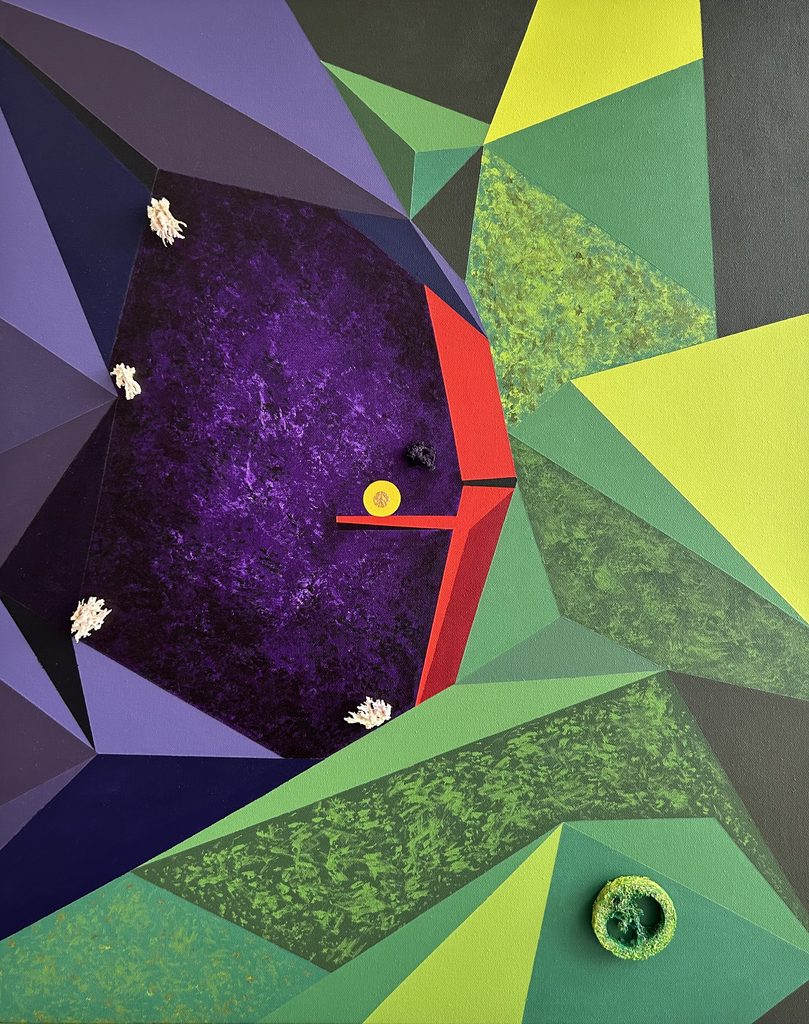
This work is part of an ongoing cycle exploring ambivalent states of contemporary existence.
Title: Offering
Medium: Acrylic and assemblage on canvas
Year: 2026
Format: Portrait format (24 × 30 inches)
Colour Space: Violet, aubergine and deep blue define the realm of the dead. Greens, mint and luminous yellow-green form the world of the living. The vermilion closure, golden offering, pale ancestral fragments and a dark-violet fragment provide focal accents.
Stylistic Classification: Geometric, folded colour planes meet irregular surface textures and sculptural elements. The clearly defined outer world surrounds a shadowed interior whose depth remains elusive.
„Offering” is inspired by a discussion of Chinese ancestor veneration at Temenggong Artists-in-Residence in Singapore. Offering asks what the living owe the dead—and how much influence the dead should retain over life.
Care for the Dead
Four pale fragments anchored to the enclosure represent successive generations kept present through remembrance and ritual. A golden offering extends into their realm on a red ledge, expressing gratitude, respect and the wish to sustain a relationship beyond death.
The violet interior holds an uncertain presence. Giving the dead a place also gives the living a sense of continuity: an acknowledgement of those who helped shape their lives
Protection of the Living
The red closure bows outward, while a green point presses against it from outside. A narrow slit allows an offering to pass through, yet limits movement in the opposite direction. The dark-violet fragment approaching this opening suggests an unsettled presence seeking a way beyond its allotted space.
Outside, shifting greens, irregular textures and an open sculptural form evoke growth and renewal. This world expresses an equally valid need: room for the living to pursue their own lives. The offering can therefore serve as both affection and appeasement.
Conclusion
“Offering” holds care and self-protection in tension. Sustaining a bond gives the past a place in the present; protecting the living requires limits on its reach. The same gesture can honour the dead and seek release from their demands—without fully resolving either need. True to the Integrity of Ambivalence.