
This work is part of an ongoing cycle exploring ambivalent states of contemporary existence.
Title: Devotion
Medium: Acrylic on canvas
Year: 2026
Format: Portrait format (24 × 30 inches)
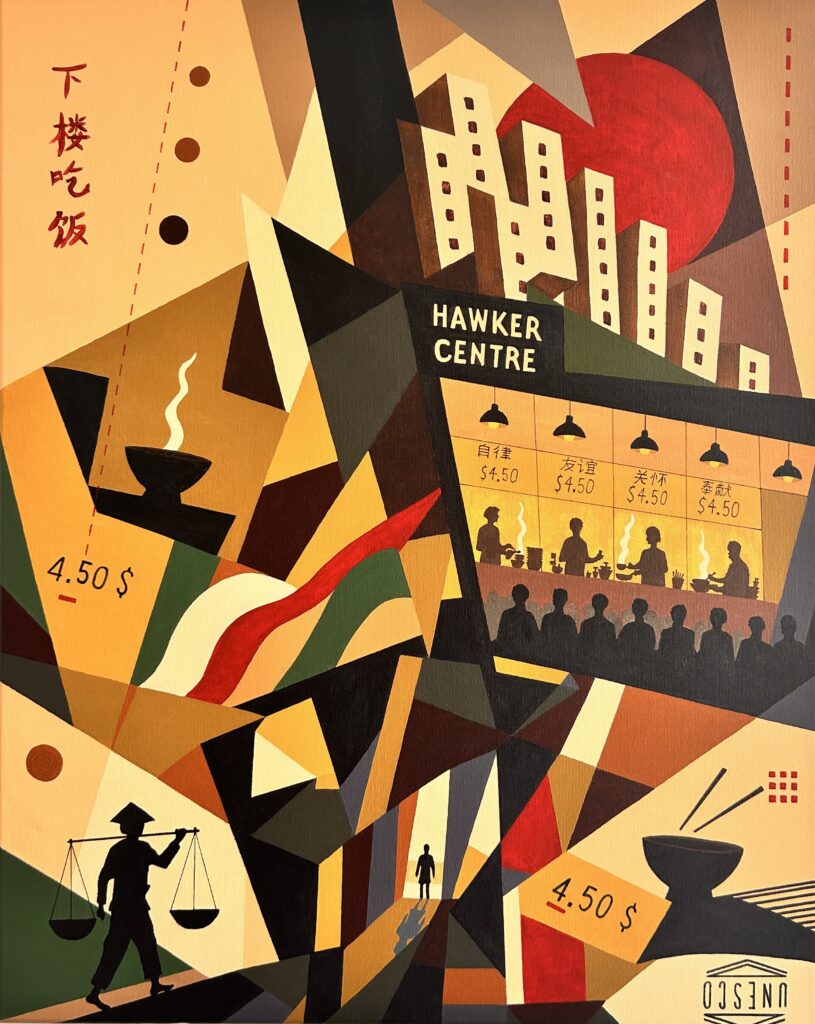
Colour Space: The chromatic structure of Devotion is anchored in the sensory and symbolic vocabulary of Singapore’s hawker culture. Chilli red, turmeric yellow, pandan green, soy brown and muted concrete tones evoke nourishment, memory, urban intimacy and continuity, while recurring red graphic elements and the monumental crimson sun introduce references to Chinese symbolism — vitality, ritual, endurance and collective belonging. Black geometric structures interrupt these warm colour flows, evoking regulation, administrative systems and the controlled infrastructures underlying Singapore’s hawker ecology.
Stylistic Classification: The work combines geometric abstraction, constructivist poster aesthetics, symbolic urban semiotics, and East Asian visual coding.
„Devotion“ interprets Singapore’s hawker culture not merely as a culinary environment, but as an ecosystem of everyday ritual, inherited labour and socially organized care. At the centre of the composition stands the illuminated hawker centre, framed by HDB towers and overshadowed by a monumental red sun that functions both as an urban symbol and as a reference to continuity, collective vitality and cultural memory.
The Chinese calligraphic inscription “下楼吃饭” (“go downstairs to eat”) introduces a profoundly ordinary yet culturally intimate gesture. In many Singaporean and broader Chinese-speaking urban contexts, this phrase carries meanings far beyond physical movement. It signifies routine, family structure, neighbourhood familiarity and the social ritual of shared meals. Eating becomes not merely consumption, but participation in communal life.
The fragmented pathways and ascending spatial movement suggest circulation — of food, labour, migration, memory and generational continuity. The painting therefore presents the hawker centre as both civic infrastructure and emotional anchor within urban life.
Devotion as Collective Care
From an affirmative perspective, Devotion foregrounds hawker culture as a remarkable system of collective care embedded within ordinary daily existence.
The repeated gestures of cooking, serving, preparing bowls and feeding crowds become acts of quiet devotion. Food functions as social infrastructure: affordable, accessible, communal and deeply interwoven with Singaporean identity. The silhouetted crowd beneath the stalls suggests interdependence rather than individuality; belonging emerges through participation in shared ritual.
The red sun and recurring numerical motifs reinforce ideas of continuity and endurance. The solitary circle at the lower left may be interpreted as origin or ancestral beginning, while the three circles above imply temporal progression and generational continuity. The nine red squares suggest stability, longevity and completeness within Chinese symbolic traditions.
The repeated “4.50$” references accessibility and affordability, emphasizing the social function of hawker culture as everyday nourishment for all layers of society. In this reading, governance and regulation become enabling structures through which cultural continuity and communal accessibility are maintained.
Devotion as Lived Obligation
At the same time, Devotion contains a persistent undercurrent of exhaustion, compression and systemic control.
The black geometric forms do not merely structure the image — they fragment and constrain it. Organic colour flows are channelled through rigid architectural systems, suggesting that spontaneity and tradition have become administratively regulated.
The repeated “4.50$” markings therefore carry an ambivalent meaning. While they signify affordability and social accessibility, they also imply economic compression and the expectation that hawker food must remain permanently inexpensive. Affordability becomes not only care, but obligation — a socially regulated condition imposed upon labour.
The figure with the elongated shadow at the centre of the composition introduces the psychological shadow side of hawker life. Positioned within a narrow corridor of fragmented geometry, the figure evokes isolation, exhaustion and the invisible emotional burden underlying repetitive labour and inherited survival structures.
In contrast, the Chinese labourer with the traditional hat at the lower left references the historical origins of Southeast Asian street food culture. Positioned partially outside the dominant illuminated infrastructure, he appears both foundational and historically displaced — a reminder of the informal labour systems absorbed and transformed by modernization.
The inverted UNESCO emblem subtly destabilizes the notion of heritage preservation, questioning whether institutional recognition truly safeguards living culture or transforms it into regulated identity.
Conclusion
„Devotion” explores how nourishment, labour, memory, regulation and identity become structurally entangled within contemporary urban life. Devotion is not purely emotion — it is repetition, obligation and social ritual at once. Hawker culture appears simultaneously as sanctuary and system: a fragile coexistence of warmth and exhaustion, care and pressure. Its humanity resides precisely within this unresolved tension. The work follows the principle of the Integrity of Ambivalence.