
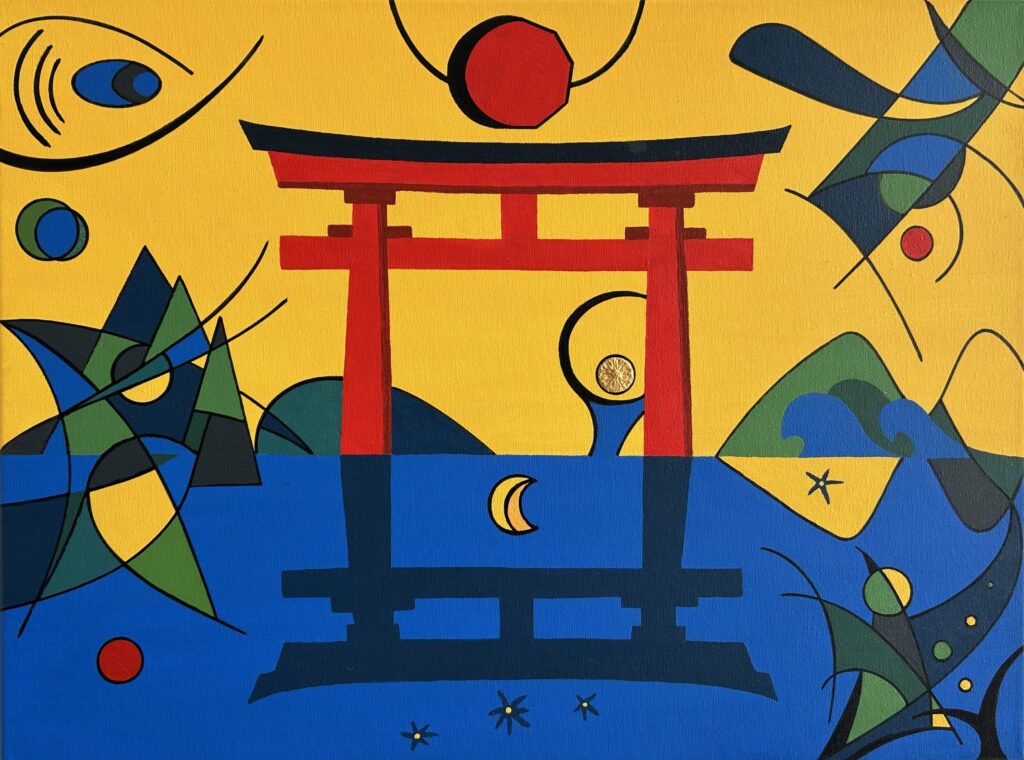
This work is part of an ongoing cycle exploring ambivalent states of contemporary existence.
Title: Dreamland
Medium: Acrylic on canvas
Year: 2024
Format: Landscape format (18 × 24 inches)
Colour Space: A reduced yet symbolically charged palette dominated by red, blue, and gold tones, complemented by black and muted natural hues. Colours are deliberately intensified and at times unnatural. Rather than serving realism, they function as carriers of emotional, cultural, and ideological meaning, articulating tension and inner conflict.
Stylistic Classification: Contemporary geometric-symbolic painting influenced by constructivist principles of order and spiritual-cultural symbolism. The work combines a restrained formal language with narrative depth, positioned between abstraction and symbolic figuration.
„Dreamland“ brings together the torii gate, sun, moon, water, mountains, and sea creatures in a quiet yet tension-filled composition. What first appears harmonious reveals fractures on closer inspection, pointing to inner conflict.
Affinity and Cultural Depth
The torii marks the threshold between the visible and invisible worlds. Sun and moon represent the rhythm of day and night, activity and rest. A whale carries a golden sphere symbolizing balance, wisdom, and responsibility. The shape also suggests a chrysanthemum – the imperial seal – as a symbol of perfection. Mountains and waves unite permanence and change; the image honors a culture that understands nature, spirituality, and order as intertwined.
Fractures Beneath the Surface
From a critical perspective, harmony collapses: the unnaturally red, visibly suspended sun no longer appears as a source of life but as a controlled, ideologically charged symbol of power. Its absence from the water’s reflection—where only the moon appears—signals a rift between outward order and inner reality; water becomes the realm of the suppressed and unspoken.
The strict geometry and tamed nature suggest conformity and hierarchy, with external strength concealing internal conflicts, leading to pressure, exhaustion and silent self-denial.
Conclusion
The work invites the viewer to feel this conflict directly — between admiration and unease, between belonging and critical distance. Ambivalence does not reside in the culture alone, but in the one who encounters it. The work follows the principle of the integrity of ambivalence.